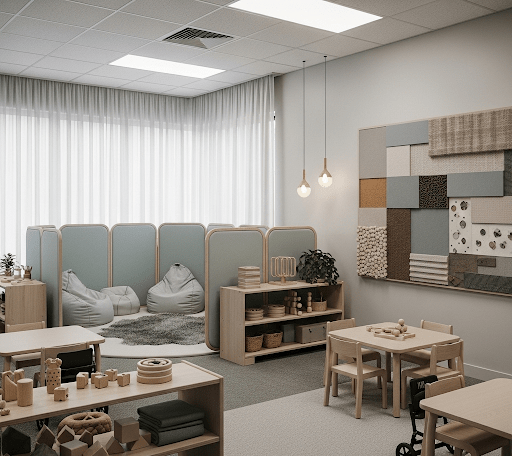
In the last blog, we stepped into the sanctuary of the sensory room. In the “Design For Ability: Beyond The Obvious” series, I spoke about how those special spaces can be a lifeline. Today, let’s take that big idea, walk it out the door, and bring it into the very heart of school life: the classroom.
Picture the classic school classroom. The flicker and hum of the lights overhead. The scrape of thirty chairs on a tile floor. Walls that are a chaotic riot of posters. It’s an environment that a lot of students just… manage. But for many others, it’s a full-blown sensory assault. This summer, I had a student transfer to my class. His previous teacher warned me that he was very fidgety, had a hard time completing assignments, and often distracted others. On his first day, I quickly noticed that he constantly fidgeted with his hands. The next day, I gave him a squishy gel stress ball to use during class. Before the following class, his Course Leader approached me and told me about her encounter with the student. She had run into him and he anxiously asked what she had told me. She simply replied, “absolutely nothing.” The Course Leader explained that he gets very nervous in new settings, which makes him even more fidgety. The stress ball was able to soothe his nerves and help him focus. That tiny tweak to his physical world was the key that unlocked his ability and to redirect his focus on the task at hand. It’s a powerful reminder that sometimes the biggest roadblocks to education have nothing to do with the curriculum.
The Classroom Conundrum: Why Sensory Design Matters
That traditional, one-size-fits-all classroom was built for an imaginary student who can tune out the world with ease. But our classrooms are filled with a vast range of minds. For students with sensory processing differences, autism, or ADHD, that “normal” classroom is a recipe for stress and anxiety. For them, just being there can get in the way of making friends and feeling like they belong, something backed up by recent research (van der Klink et al., 2021). Can you even imagine trying to solve a math problem when the lights are buzzing in your skull and your shirt feels like it’s made of sandpaper? This isn’t just about being comfortable. It’s about basic fairness and the right to learn
And here’s the thing: sensory needs are all over the map. You have kids who are hypersensitive, where every sound is a siren and they need calm to function. Then you have kids who are hyposensitive, who actually need more input—movement, pressure—just to feel present and engaged. A sensory-friendly classroom isn’t about creating a sterile, boring box. It’s about creating a space with options, a space where students can find their “just-right” so they can finally get to the business of learning.
From Overload to Opportunity: Principles of Sensory-Friendly Learning Spaces
So, what’s the fix? It’s all about getting ahead of those environmental roadblocks to learning. This idea is the heart of a framework called Universal Design for Learning (UDL). The big idea is that when you design for students at the margins, you actually end up making things better for everyone (López-Gavira et al., 2021). It’s just more humane design.
So what does that actually look like?
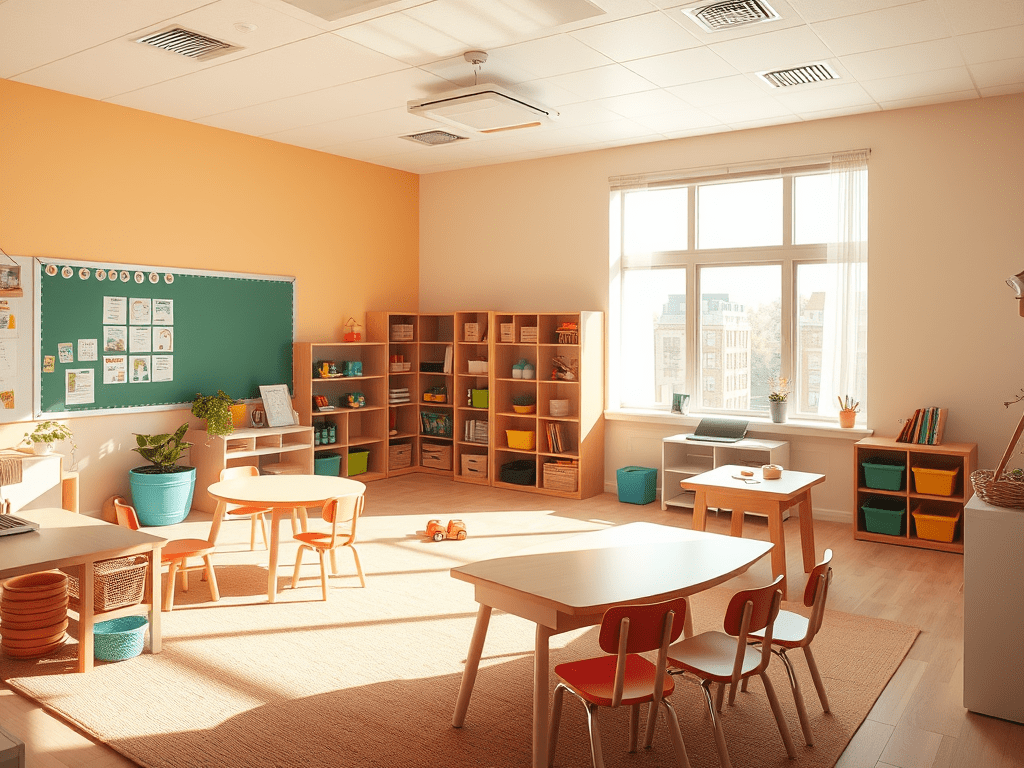
Let’s look at how this translates into practical classroom design:
- First up, our eyes. Visual chaos is exhausting. That means trading the harsh fluorescents and cluttered walls for calmer options. Think natural light whenever possible, maybe some dimmable LEDs, and walls with neutral colors and—this is important—some empty space. It gives the eyes a place to rest. And it’s not just a nice idea; new studies show a direct line between a classroom’s physical environment, including its lighting, and how productive and well students feel (Wójcik, 2023).
- Then there’s the noise. That constant, low-grade hum of a classroom, the echoes, the chair scrapes. It’s not just annoying; it’s a cognitive drain. And it’s not just a hunch; a huge review of recent studies shows that all that background noise genuinely messes with kids’ thinking and learning (Renz et al., 2021). The fixes can be surprisingly simple. Rugs, wall fabrics, acoustic panels, even the old trick of putting tennis balls on chair legs. They all work to soak up sound and make the space calmer.
- Movement is not the enemy. Let’s say that again. Movement is not the enemy. Forcing kids into rigid chairs for hours on end goes against their neurology. Flexible seating—wobble stools, standing desks, beanbags—isn’t a gimmick. It’s about giving kids what their bodies are asking for to help their brains focus. While researchers are still digging in, the evidence so far points to flexible classrooms boosting student engagement and learning (Kariippanon et al., 2020).
- Creating Zones for Different Needs: A single room can be designed to support various sensory needs. This can be as simple as setting up a “calm-down corner” with soft cushions and a weighted lap pad, a separate area for focused individual work, and another space for collaborative or more active learning. This zoning gives students the freedom to choose the space that best fits their current learning and sensory needs.
Designing for All: The Ripple Effect of a Thoughtful Environment
And here’s the cool part. These changes don’t just help a few kids; they lift up the whole classroom.
- When the environment is calmer and more organized, all students feel less anxious. It frees up precious brainpower for critical thinking, for creativity, for actually connecting with each other. Kids who learn to recognize what they need from their environment are learning a skill for life: self-regulation.
- And for teachers? It’s a game-changer. Classroom management becomes less about policing behavior and more about supporting students. A calmer room means a less stressed teacher, one who has the energy to do what they love. The room itself becomes a teaching partner, not another daily battle (Wójcik, 2023).
At the end of the day, this isn’t just a trend. It’s a fundamental shift toward more compassionate and effective education. We need to think about the whole school—the roaring cafeteria, the crowded hallways, the library. By shaping these spaces with our senses in mind, we build schools where every single student can feel safe, supported, and ready to soar.
So, think about the school you know best. What does it feel like? What’s one small thing you could do to make it a little bit kinder to the senses? That’s where the quiet revolution begins.
References:
- Kariippanon, K. E., Eime, R. M., & Westerbeek, H. (2020). A systematic review of the evidence for learning in flexible learning spaces. International Journal of Educational Research, 104, 101680. https://doi.org/10.1016/j.ijer.2020.101680
- López-Gavira, R., Moriña, A., & Melero-Aguilar, N. (2021). How to build an inclusive university? An analysis of the challenges of inclusion from the perspective of students with disabilities. Disability & Society, 36(8), 1279–1298. https://doi.org/10.1080/09687599.2020.1783100
- Renz, T., Le-Corvec, T., & Canivet, C. (2021). The effect of noise on children’s health and cognition: A systematic review of the literature (2014–2019). Noise & Health, 23(109), 65–77. https://doi.org/10.4103/nah.NAH_51_20
- van der Klink, A. A., van der Wilt, G. J., Schoonmade, L. J., van der Heijden, I. M., & van den Heuvel, E. (2021). The impact of sensory stimuli on the social participation of children with autism spectrum disorder in the school environment: A systematic review. European Journal of Special Needs Education, 36(5), 780–796. https://doi.org/10.1080/08856257.2020.1798547
- Wójcik, K. (2023). The importance of indoor environmental quality in educational buildings in shaping the well-being and productivity of students. Buildings, 13(2), 552. https://doi.org/10.3390/buildings13020552
About the Author
This post is written by Taylor Adapt, a Special Education teacher with experience in both Mild/Moderate and Moderate/Severe settings. The use of the pseudonym allows for focus on the shared experiences and insights of the community, maintaining objectivity in this exploration of accessible design.

 DesignForAbility: Enhancing Daily Living
Leave a reply to Laura Cancel reply